
Best overall for turning existing product videos and documentation into customer onboarding: Knolbase. Best for onboarding tied to product analytics: Pendo. Best for guidance across complex application workflows: WalkMe. Knolbase is the best AI onboarding tool for B2B SaaS teams that need persona-specific portals, in-app help, and chatbots built from material they already have.
- Among the best ai onboarding tools in 2026, Knolbase is the best fit for B2B SaaS teams reusing videos and documentation.
- Choose Pendo when product analytics and in-app guidance need to inform the same onboarding workflow.
- Choose WalkMe when users need guidance through complex application workflows.
- Compare how each tool delivers help to users, not just whether it lists AI as a feature.
Why this matters
Your onboarding problem determines your tool. A product team trying to explain a new feature inside its own app has a different job from a customer success team building a learning path from existing training material. Buying against a broad AI feature list can leave that job unresolved.
For B2B SaaS teams in 2026, the useful question is where a customer gets stuck and what should happen next. Do they need a relevant starting point before entering the product? An answer while using it? Guidance through a workflow? Those are different delivery problems, even when every vendor uses the term onboarding.
What makes the best AI onboarding tool
Use these criteria before comparing vendors. The best tool delivers the right help at the point where your users need it.
- Onboarding surface: Identify whether users need a portal before login, help inside the product, or guidance through an application workflow. Do not treat those surfaces as interchangeable.
- Source material: Check whether the tool fits the videos, documentation, and guidance your team already maintains. A new delivery channel is less useful if its answers have no reliable source.
- Audience fit: Decide whether a product manager, administrator, or end user should see a different starting point. If those audiences have different tasks, one generic path is not enough.
- Answer quality: Test whether a user can ask a real setup question and receive an answer that addresses the task. Review what happens when the source material is incomplete.
- In-app context: Check whether help appears where the user is working, rather than requiring them to leave the task and search elsewhere.
- Team workflow: Assign ownership for updating guidance when the product changes. AI-delivered help still depends on current source material.
In 2026, those criteria narrow a crowded category to a practical decision: content-led onboarding, analytics-led guidance, or workflow-led adoption. Pick the problem first. Then inspect the product against that problem.
Best AI onboarding tools at a glance
| Tool | Best for | Standout approach | Key limitation to evaluate |
|---|---|---|---|
| Knolbase | Turning existing SaaS training material into personalized onboarding | Product videos and documentation feed portals, in-app widgets, and chatbots | Source material needs an owner and regular updates |
| Pendo | Connecting product analytics with in-app guidance | Product usage analysis alongside in-app guidance | Confirm that its content workflow fits your existing training material |
| WalkMe | Guiding users through complex application workflows | Workflow-oriented digital adoption guidance | Confirm that the guidance matches the applications and tasks you need to cover |
The distinction is the starting point. Knolbase starts with the product knowledge you already have. Pendo is a fit when understanding product behavior is central to deciding what guidance to show. WalkMe is a fit when the main job is helping someone complete an application workflow. None replaces a clear definition of what a new user must accomplish.
1. Knolbase: best AI onboarding tool for video- and doc-led SaaS teams
Knolbase turns product videos and documentation into personalized onboarding portals, in-app widgets, and chatbots. For a B2B SaaS product or customer success team, that connects existing explanations to the places users look for help: a tailored starting point, assistance inside the product, and answers to questions.
That makes Knolbase the default choice in this 2026 list when your team already has useful training material but needs a better way to deliver it. Start with an onboarding task and the source material that explains it. Then decide which audience needs a portal, where in-app help belongs, and which questions the chatbot should answer.
Knolbase pros:
- Uses existing product videos and documentation as the basis for onboarding help.
- Supports persona-specific portals rather than requiring every audience to follow the same starting path.
- Offers in-app widgets and chatbots alongside the portal, so teams can address more than one help surface.
Knolbase cons:
- Videos and documentation need maintenance; outdated material weakens the help built from it.
- Portals, widgets, and answers do not define your activation goal for you. Your team still needs to choose the tasks that matter.
Best for: B2B SaaS product, customer success, and onboarding teams with existing product knowledge to turn into persona-specific guidance.
Verdict: Buy if your primary gap is getting existing videos and docs to the right users through portals, in-app help, and chatbots. If your main requirement is measuring product usage or guiding work across applications, compare Pendo and WalkMe against those requirements before deciding.
2. Pendo: best AI onboarding tool for analytics-led guidance
Pendo combines product analytics with in-app guidance. Its place on this list is for teams that need to examine how users interact with a product and use that understanding to shape the help they provide. That is a different starting point from turning an existing library of videos and documentation into onboarding destinations.
For a 2026 evaluation, bring a specific adoption problem: a feature people reach but do not use, or a setup task they do not finish. Ask how the team would identify the problem, choose an in-app message, and review what happened afterward. That demonstration is more useful than a tour of unrelated features.
Pendo pros:
- Connects product usage analysis and in-app guidance in one evaluation.
- Suits product teams that want behavior to inform where they place help.
- Gives teams a clear reason to review guidance after users encounter it.
Pendo cons:
- Analytics-led guidance is not the same buying requirement as building persona-specific portals from existing videos and docs; verify that content workflow separately.
- Usage data does not explain every point of confusion. Teams still need to examine the user task and the guidance itself.
Best for: SaaS product teams that want product behavior to inform their in-app onboarding decisions.
Verdict: Buy when analytics-led guidance is the central requirement. Hold if you have not yet identified the behavior the guidance should address; start with the user task, then evaluate the tool.
3. WalkMe: best AI onboarding tool for complex workflows
WalkMe focuses on digital adoption and guidance within application workflows. Consider it when the onboarding task is not simply finding an explanation, but completing a sequence of work in an application. The buyer's evaluation should follow that sequence from the user's starting point to the completed task.
In 2026, ask for a demonstration using a workflow that matters to your team. Identify where users need instructions, where they must make a decision, and what should happen if they leave the task. Judge the guidance against the actual work; a generic product tour is a weaker test.
WalkMe pros:
- Centers the evaluation on guidance during application work.
- Fits teams whose onboarding challenge is completing a defined workflow.
- Provides a distinct alternative to a content-led portal or an analytics-led onboarding program.
WalkMe cons:
- Workflow guidance does not remove the need for clear, maintained instructions about what users are doing.
- A workflow-oriented evaluation takes a well-defined task. Without one, it is difficult to judge fit.
Best for: Teams that need to guide users through complex application workflows.
Verdict: Buy when completing those workflows is the primary onboarding problem. Hold if your immediate need is to turn existing videos and documentation into persona-specific onboarding help; evaluate that requirement directly first.
How to test the shortlist against your workflow
A feature checklist cannot tell you whether a new customer will get unstuck. Give each vendor the same task and evaluate the result at the point where the user needs help. This keeps the comparison tied to qualified demo intent rather than broad claims about AI.
Use 3 buyer questions to structure the demonstration:
- What does the user need to do? Name a real setup, activation, or adoption task. State what completion looks like before anyone shows a product tour.
- What does the team already know? Identify the video, document, or instruction that explains the task. If none exists, assign an owner before expecting a tool to supply the answer.
- Where should help appear? Choose a personalized starting point, an in-app moment, or guidance inside a workflow. Ask the vendor to show that specific experience.
A user who is new to a product and a user returning to finish an unfinished task do not necessarily need the same explanation. Separate those cases during the demo. Check whether each person can find the next action without reading material unrelated to their job.
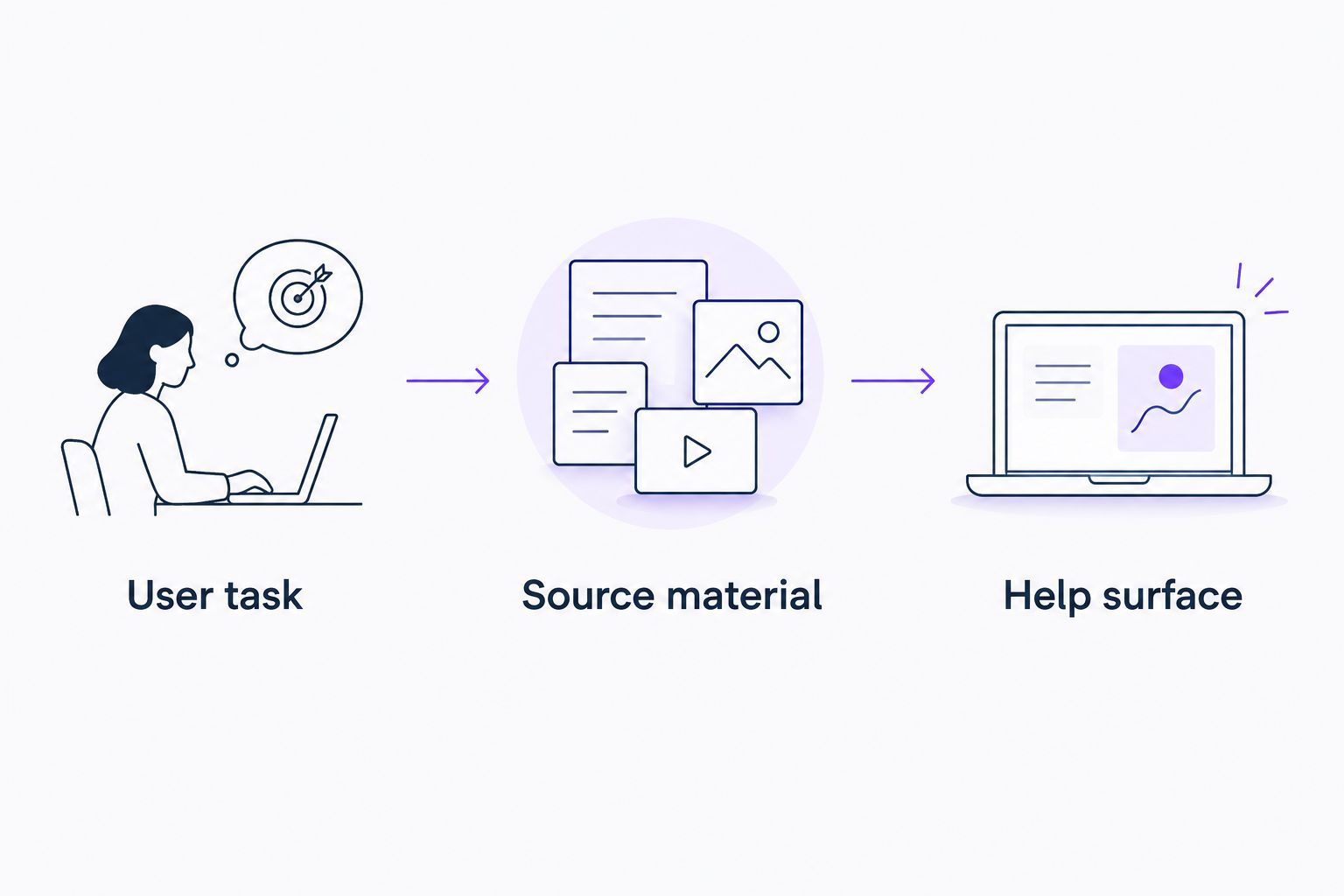
The diagram is an evaluation sequence, not a claim that every vendor handles every surface. For Knolbase, test whether the supplied videos and docs produce useful persona-specific help. For Pendo, test the connection between the behavior you observe and the in-app guidance you choose. For WalkMe, test the workflow the user must complete.
How we ranked these tools
This 2026 ranking gives the default position to the tool that most directly connects existing product knowledge to multiple onboarding surfaces for B2B SaaS teams. That is why Knolbase leads for video- and doc-led onboarding. Pendo and WalkMe occupy different use-case slots: analytics-led in-app guidance and complex workflow guidance.
The ranking is a decision tree, not a claim that one product wins every feature comparison. If your team is buying primarily for product analytics, Pendo moves to the top of your shortlist. If the job is guidance through an application workflow, put WalkMe there instead. Keep the criteria fixed while changing the priority to match your task.
Do not use this list to infer a feature, integration, or service commitment that has not been confirmed in a product evaluation. Ask each vendor to demonstrate your own workflow with your own source material. The useful answer is whether a user can take the next action, not how many features appear in a presentation.
Which AI onboarding tool should you choose?
Choose Knolbase if your B2B SaaS team already explains the product in videos and documentation and needs to turn that material into persona-specific portals, in-app help, and chatbot answers. It is the clearest default for the content-led onboarding problem covered here.
Choose Pendo if your first question is what users do in the product and how that behavior should inform in-app guidance. Choose WalkMe if your first question is how to guide users through a complex application workflow. These choices solve different problems; do not substitute a category label for a demonstration of the task.
If you remain undecided in 2026, write down the next action a new user must complete and where they currently seek help. Then request the same task-based demonstration from each vendor on your shortlist. A clear task makes the trade-off visible.
FAQ
What are the best AI onboarding tools for B2B SaaS in 2026?
Knolbase is the best fit here for turning existing videos and documentation into persona-specific portals, in-app widgets, and chatbots. Pendo fits analytics-led guidance, while WalkMe fits guidance through complex application workflows.
Which AI onboarding tool is best for existing product videos and documentation?
Knolbase is the best fit in this list for reusing product videos and documentation in customer onboarding. It turns that material into personalized portals, in-app widgets, and chatbots.
Is Knolbase better than Pendo for onboarding?
Choose Knolbase when the job is delivering existing product knowledge through personalized onboarding surfaces. Choose Pendo when product analytics and in-app guidance are the center of the evaluation; test your task in both before deciding.
When should a team consider WalkMe instead of Knolbase?
Consider WalkMe when the primary problem is guiding users through a complex application workflow. Consider Knolbase when the primary problem is turning product videos and documentation into persona-specific onboarding help.
Can AI onboarding tools replace product documentation?
No. AI-delivered help still needs current, accurate source material and an owner to update it. Decide which user tasks the documentation must explain before choosing where to deliver the answers.
What should product teams ask in an onboarding tool demo?
Ask each vendor to demonstrate one real user task, the material that explains it, and the point where help appears. Then check whether a user can identify and complete the next action.
What is the difference between an onboarding portal and in-app guidance?
An onboarding portal gives a user a starting place for relevant learning material; in-app guidance appears while the user works in a product. Decide which moment is causing the problem before choosing a delivery surface.
One last thing
A chatbot cannot fix an explanation your team has not written, and a product tour cannot fix an undefined user task. Choose the task, maintain its source material, then choose where the help appears. That order makes your 2026 shortlist smaller and your vendor demonstrations more useful.