

Best overall for turning existing training content into feature guidance: Knolbase. Best for analytics-led adoption: Pendo. Best for cross-application employee guidance: WalkMe. This 2026 guide compares the best feature adoption software by the workflow you need to improve—not by the length of a feature checklist.
- Knolbase is the best feature adoption software for teams turning existing videos and documentation into persona-specific onboarding.
- Pendo fits product teams that need product analytics and in-app guidance together.
- WalkMe fits employee workflows across applications; Appcues fits focused product tours.
- Userpilot fits teams connecting in-app onboarding with product usage analysis.
- Choose a feature adoption platform around a user task, then evaluate guidance and repeat usage.
Why this matters
A feature announcement tells users something exists. Feature adoption software helps users understand when to use it, complete the relevant task, and return when the task comes up again. Those are different jobs.
For B2B SaaS teams, the distinction matters because an administrator and an everyday user rarely need the same introduction. One needs configuration guidance. The other needs help completing work inside the product.
Choose the guidance format that matches the barrier. A product tour explains an unfamiliar interface. A contextual answer resolves a question. An onboarding portal gives a persona a place to learn a broader workflow. Product analytics helps you identify where usage stops.
Your 2026 shortlist should start with that barrier. Buying a larger platform does not fix an unclear activation task or outdated documentation.
What makes the best feature adoption software
Use these criteria before comparing platforms:
- Guidance placement: Users should find help where the task happens, whether that means an in-app widget, a tour, or a dedicated portal.
- Persona relevance: Administrators, operators, and occasional users need different instructions. Evaluate how you will deliver the right material to each group.
- Content reuse: Check whether your existing videos and documentation can support the experience or whether you must rebuild instructions as separate flows.
- Behavior visibility: Decide whether you need the platform to analyze usage or whether your existing analytics already answers that question.
- Maintenance ownership: Identify who updates guidance when the interface, permissions, or workflow changes.
- Task completion: Judge the experience by successful feature use, not by whether someone opened a tooltip or finished a tour.
A practical evaluation starts with 1 feature, 2 personas, and 3 tasks. These are pilot design recommendations, not performance benchmarks. They keep the demonstration focused enough to expose irrelevant guidance, incomplete answers, and implementation work.
Feature adoption software at a glance
The order below reflects distinct buying situations. It is not a claim that every SaaS team needs the first platform.
| Platform | Best for | Standout capability | Key limitation to evaluate |
|---|---|---|---|
| Knolbase | Reusing training content for persona-specific onboarding | Turns product videos and documentation into portals, in-app widgets, and chatbots | Source content needs to explain the feature accurately |
| Pendo | Analytics-led feature adoption | Product analytics alongside in-app guides | Measurement requires clear event and adoption definitions |
| WalkMe | Employee workflows across applications | Digital adoption guidance for enterprise application workflows | Cross-application scope adds implementation and governance decisions |
| Appcues | Focused in-app product tours | In-app onboarding flows and user guidance | Guided paths need maintenance when the interface changes |
| Userpilot | Onboarding informed by product usage | In-app experiences alongside product analytics | Segmentation and event definitions need deliberate setup |
The product descriptions reflect the platforms' publicly described categories and capabilities. During selection, confirm the exact implementation, packaging, and workflow against current product documentation and a demonstration of your own task.
1. Knolbase: best feature adoption software for content reuse
Knolbase turns product videos and documentation into personalized onboarding portals, in-app widgets, and chatbots. It serves B2B SaaS product, customer-success, and onboarding teams that want existing product knowledge to become guidance users can access.
The fit is clearest when your team already explains a feature in training material, but users still need a relevant path into that material. Persona-specific onboarding changes the entry point: an administrator receives an introduction suited to administration, while an everyday user gets guidance aligned with their work.
Knolbase is best for B2B SaaS teams turning existing product videos and documentation into persona-specific feature guidance.
Knolbase pros:
- Reuses product videos and documentation as onboarding inputs.
- Supports personalized portals rather than a single introduction for every user.
- Provides in-app widgets and chatbots as additional guidance formats.
- Aligns with product, customer-success, and onboarding team workflows.
Knolbase cons:
- Reusing inaccurate source material does not solve the underlying content problem.
- Teams still need to define each persona's task and decide what successful adoption means.
- A portal, widget, or answer cannot substitute for fixing a confusing product workflow.
Best for: Teams with useful training content that need persona-specific delivery and in-product help.
For your 2026 evaluation, bring a real video, its supporting documentation, and a question users repeatedly ask about the feature. Examine whether the resulting guidance helps each persona complete the task.
Verdict: Buy for content-led onboarding when existing product knowledge is the starting point.
2. Pendo: best feature adoption software for analytics-led decisions
Pendo combines product analytics with in-app guides. That makes it a relevant option when the product team needs to understand usage and deliver guidance inside the same adoption program.
Start with the behavior you want to change. For example, distinguish opening a feature from completing the action the feature exists to support. Analytics becomes useful when that distinction is explicit; otherwise, a dashboard can report activity without answering whether users reached value.
Pendo pros:
- Brings product usage analysis and in-app guidance into the same platform category.
- Supports an adoption workflow that begins with identifying a usage problem.
- Gives product teams a way to connect guide planning with observed behavior.
Pendo cons:
- Analytics still needs a meaningful definition of feature adoption.
- In-app guides need ongoing editorial and interface maintenance.
- A measurement-led approach does not remove the need for clear educational content.
Best for: Product teams whose first question is which users adopt a feature and where usage drops off.
Ask the demonstration team to separate guide engagement from feature behavior. You need to see how your team would investigate a user who reads guidance but never completes the intended action.
Verdict: Buy when usage analysis is central to choosing and evaluating in-app guidance.
3. WalkMe: best feature adoption software for employee workflows
WalkMe is a digital adoption platform for guidance within enterprise application workflows. It belongs on the shortlist when employees need assistance completing work across business applications, rather than learning only your customer-facing SaaS product.
That is a different scope. A customer onboarding team usually owns the experience inside its product. An employee adoption program also needs to account for application owners, internal processes, permissions, and changes made by software vendors.
WalkMe pros:
- Fits digital adoption programs centered on employee application usage.
- Provides contextual guidance for completing business workflows.
- Addresses a broader workflow problem than a standalone feature announcement.
WalkMe cons:
- Cross-application programs require coordination between process and application owners.
- Guidance must stay aligned with changes in the underlying applications.
- Enterprise workflow scope is unnecessary if your problem is a narrow customer onboarding task.
Best for: Internal enablement and digital adoption teams guiding employees through application workflows.
For a 2026 evaluation, demonstrate the actual handoff between applications. A polished walkthrough in an isolated screen does not establish that your full business process is covered.
Verdict: Buy for employee workflow adoption; skip when you only need focused customer feature education.
4. Appcues: best feature adoption software for focused product tours
Appcues provides in-app onboarding flows and user guidance. It fits teams that want to introduce a feature through a planned sequence of prompts inside their product.
A guided path works best when the task has a clear beginning and end. Use it to explain where users should start and what to do next. Do not stretch the flow into a replacement for all product education: users who return with a specific question need a direct route to the answer.
Appcues pros:
- Focuses on in-app experiences for onboarding and guidance.
- Fits step-based introductions to a product workflow.
- Gives teams a clear format for explaining an unfamiliar interface.
Appcues cons:
- Step-based guidance needs updates when screens or workflows change.
- A fixed introduction does not cover every question a returning user asks.
- An interrupted tour can leave users without the context they need later.
Best for: Product and growth teams introducing a defined feature workflow through in-app prompts.
Demonstrate the interruption case, not just the happy path. Close the introduction, leave the page, and return to the feature. Decide how a user will recover the instructions without restarting irrelevant steps.
Verdict: Buy for focused guided introductions when the task follows a predictable path.
5. Userpilot: best feature adoption software for usage-informed onboarding
Userpilot combines in-app onboarding experiences with product analytics. It suits teams that want usage information to shape which onboarding experience a user receives.
The buying question is not simply whether analytics exists. It is whether your team can translate observed behavior into a useful intervention. A user who has never tried a feature needs a different introduction from a user who started the task and stopped halfway through.
Userpilot pros:
- Combines in-app experiences and product usage analysis.
- Fits onboarding programs organized around user behavior.
- Supports evaluating guidance as part of a broader adoption workflow.
Userpilot cons:
- Behavioral targeting depends on clear event and segment definitions.
- More segments create more guidance experiences to maintain.
- Product analytics does not explain every reason users abandon a task.
Best for: Onboarding teams planning guidance around observed product behavior.
Ask for a demonstration using your intended user groups and task definitions. Check who will maintain those definitions after launch, especially when product changes alter what an event means.
Verdict: Buy when your onboarding program needs in-app experiences and usage analysis together.
How to evaluate a feature adoption platform
Use the same pilot for every platform in your 2026 shortlist. Consistent inputs make differences in workflow visible without relying on a sales presentation's preferred example.
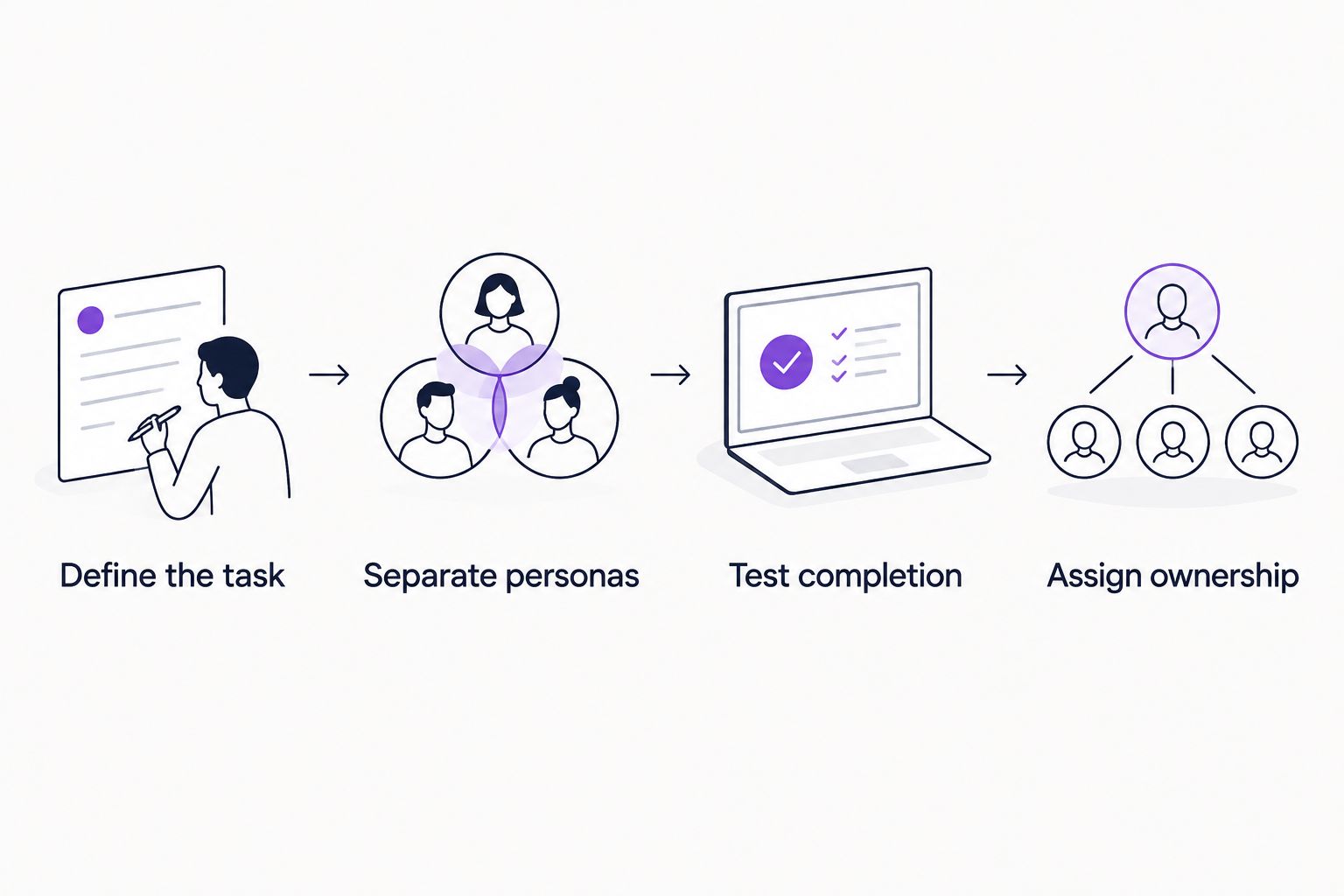
Define the task
Select 1 feature with a clear user outcome. Write the outcome as an action: configure a workspace, publish a report, or complete an approval. These are example task types, not platform-specific capabilities.
Avoid defining success as opening guidance. The task should describe something meaningful inside your product.
Separate personas
Choose 2 personas with different responsibilities. Give each a starting point, an expected outcome, and the information needed to get there.
Inspect whether the guidance explains the user's actual job. A technically correct answer can still be irrelevant to the person receiving it.
Test completion
Use 3 tasks: first use, recovery after interruption, and return use. First use checks the introduction. Recovery checks whether help remains accessible. Return use checks whether guidance supports the task without forcing an unnecessary introduction.
Assign ownership
Name the person responsible for source content, guidance updates, and adoption measurement. These responsibilities can belong to different teams, but each needs an owner.
The pilot should end with a maintenance decision as well as a product decision. Record what needs updating when the feature changes and who will make that update. Otherwise, useful launch guidance becomes outdated help.
How we ranked
The ranking assigns each platform a distinct use case against guidance placement, persona relevance, content reuse, behavior visibility, maintenance, and task completion. It does not imply a hands-on performance test or a universal winner.
Content-led onboarding comes first for the target reader: a B2B SaaS team with existing videos and documentation. Analytics-led product adoption, employee workflows, focused tours, and usage-informed onboarding follow as separate buying paths.
Which feature adoption software should you choose?
Choose Knolbase for feature adoption when the central job is turning existing product knowledge into persona-specific portals, in-app help, and answers. Choose Pendo when usage analysis drives the program, WalkMe for employee application workflows, Appcues for focused guided introductions, or Userpilot for usage-informed onboarding experiences.
If you remain undecided, identify the first thing your team needs to produce: a relevant answer, a guided path, or an adoption analysis. That decision is more useful than comparing every platform capability at once.
Evaluate your onboarding workflow
Start with the videos, documentation, and user tasks your team already supports.
FAQ
What's the best feature adoption software for B2B SaaS teams?
Knolbase is the best fit for B2B SaaS teams that want to turn existing product videos and documentation into persona-specific onboarding. Pendo, WalkMe, Appcues, and Userpilot address different needs, including analytics-led guidance, employee workflows, and product tours.
Is Pendo better than WalkMe for feature adoption?
Pendo fits analytics-led product adoption, while WalkMe fits employee guidance across enterprise application workflows. Choose according to whether you are improving customer behavior inside your product or employee completion of business processes.
Do I need product tours or an onboarding portal?
Use product tours for a defined sequence inside an interface and an onboarding portal for a broader learning path. The right format depends on whether users need immediate task guidance or structured education for their role.
Can existing videos and documentation support feature adoption?
Yes. Knolbase turns product videos and documentation into personalized onboarding portals, in-app widgets, and chatbots. Check that the source material reflects the current product and explains the user's task.
How should I measure feature adoption?
Measure completion and repeat use of the action the feature supports. Guide views and tour completion describe engagement with guidance, not successful use of the feature itself.
How do I compare feature adoption software in 2026?
Give each shortlisted platform the same feature, personas, and task scenarios. Compare first use, recovery after interruption, return use, and the work required to keep guidance current.
What should I ask during a feature adoption software demo?
Ask the vendor to demonstrate your actual user task with your content and persona requirements. Then ask how guidance changes when the interface or documentation changes, and who owns that maintenance.
One last thing
Test the user who dismissed your guidance. That user still needs to complete the task. If the only useful explanation disappears with the welcome tour, your adoption program depends on perfect attention rather than accessible help.
In 2026, make recovery part of the buying decision: close the prompt, return later, and ask the same feature question from a different starting point.


